
MTD Qualifying Income: What Counts Toward the £50,000 Threshold in 2026
Dividends, director salary, and PAYE do not count toward MTD ITSA qualifying income. HMRC rules for the April 2026 rollout explained.
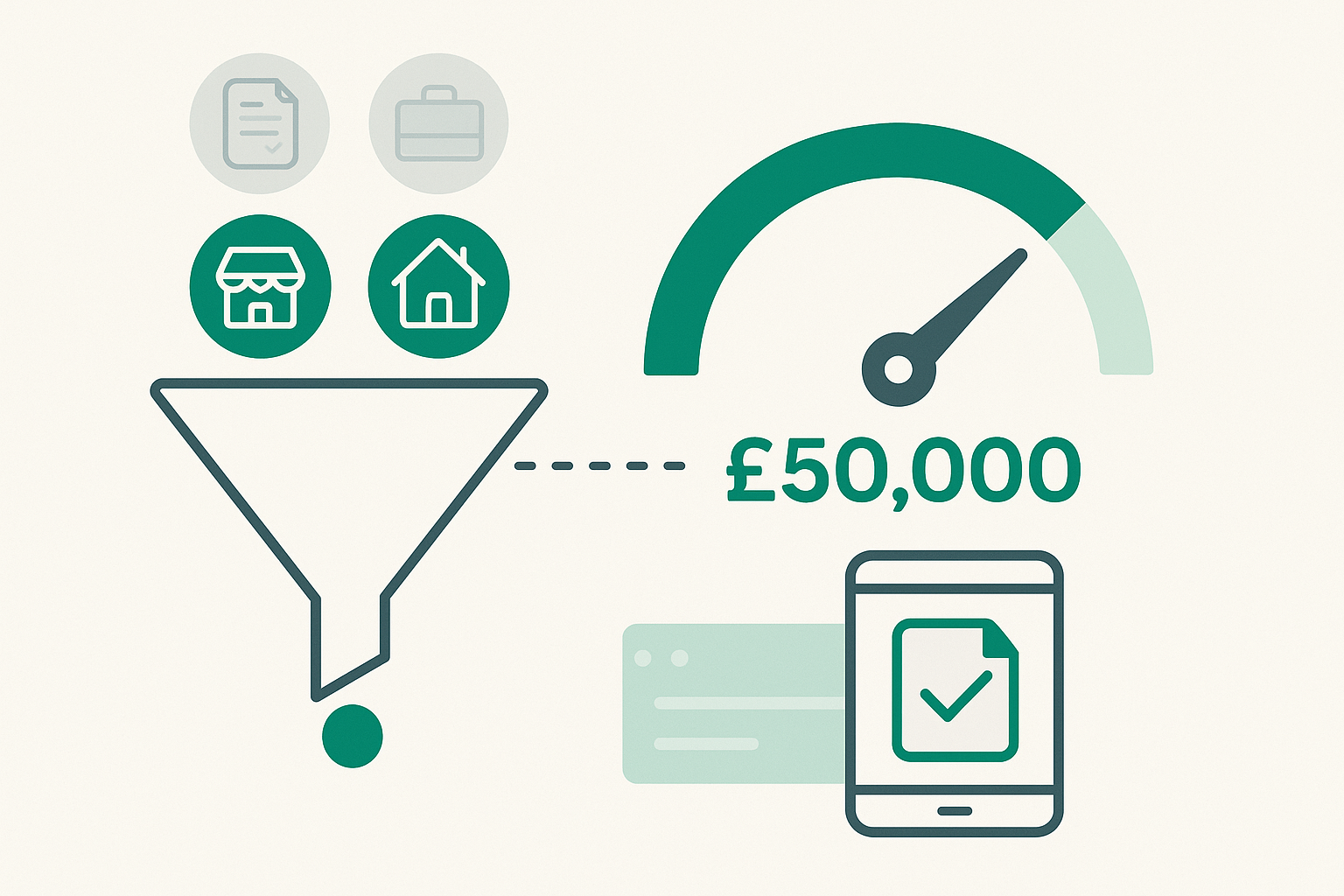
Making Tax Digital for Income Tax Self Assessment (MTD ITSA) started on 6 April 2026 for sole traders and landlords whose qualifying income exceeded £50,000 on their 2024–25 Self Assessment return. But qualifying income is narrower than total income — and many limited company directors are outside scope entirely.
HMRC counts only gross turnover from self-employment plus gross income from UK (and foreign) property. Everything else — employment PAYE, dividends from your own company, savings interest, pensions, and partnership profit shares — is excluded when deciding if you must join MTD ITSA.
What counts as qualifying income
Self-employment turnover is measured before expenses. If you invoiced £45,000 as a sole trader and had £12,000 in costs, your qualifying income is £45,000, not £33,000 profit.
UK property income is also gross — rent received before deducting mortgage interest, repairs, or agent fees. Foreign property declared on UK Self Assessment counts too.
Add self-employment turnover and property income together. If the total exceeded £50,000 on your 2024–25 return, you are in scope from 6 April 2026 unless an exemption applies.
What does not count
Director salary and dividends from your limited company are excluded. A contractor with £60,000 salary plus £30,000 dividends and no sole trade or rental income is not in MTD ITSA — the company continues to file Corporation Tax separately.
PAYE employment from any employer, State and private pensions, bank interest, and capital gains are also outside qualifying income. Partnership profit shares are reported on Self Assessment but do not count toward the MTD threshold; partners follow separate MTD partnership rules on a later timetable.
Mixed-income taxpayers need careful arithmetic. A developer with £35,000 freelance turnover, £20,000 rental income, £40,000 PAYE salary, and £5,000 dividends has £55,000 qualifying income — above the threshold — even though total income is much higher.
Thresholds rolling out through 2028
April 2026 — qualifying income above £50,000 on 2024–25 return.
April 2027 — above £30,000 on 2025–26 return.
April 2028 — above £20,000 on 2026–27 return.
Each wave uses a prior-year Self Assessment figure. Check HMRC's online tool if you started a new business after 2024–25 or expect income to drop below the threshold.
Quarterly updates and soft landing
In-scope taxpayers submit quarterly updates through MTD-compatible software, then a year-end declaration. For 2026–27, HMRC applies a soft landing — you will not be penalised solely for minor categorisation errors in quarterly updates while you adapt.
FinnAccountings maintains MTD-compatible digital records, prepares quarterly summaries, and tracks deadlines through our Compliance Agent. If you are a limited company director with only salary and dividends, you still benefit from integrated bookkeeping — but MTD ITSA quarterly filing may not apply to you personally.
Check your status before Q2 closes
Work out qualifying income from your 2024–25 return now. If you are in scope, confirm MTD ITSA registration and test software before the next quarterly deadline.
Start a free trial to see whether your income mix triggers MTD ITSA and to preview your first quarterly update from live bank feeds.
Sources & references
This article draws on official guidance and publications from the sources below.
- 1.Check if you need to follow Making Tax Digital for Income Tax
GOV.UK · Accessed 2026-06-26
- 2.Making Tax Digital for Income Tax Self Assessment
GOV.UK · Accessed 2026-06-26
Put this into practice
FinnAccountings helps with bookkeeping, tax, and VAT prep for Ireland and the UK — with Chartered Accountant insight on AI drafts. Educational articles are not filing advice.
Try AI accounting free