
UK eVED Confirmed: 3p per Mile for EVs from April 2028 — July 2026 Response
HM Treasury’s 13 July 2026 consultation response confirms Electric Vehicle Excise Duty from April 2028 at 3p per mile for battery EVs and 1.5p for plug-in hybrids — with simplified fleet rules and no mandatory trackers.
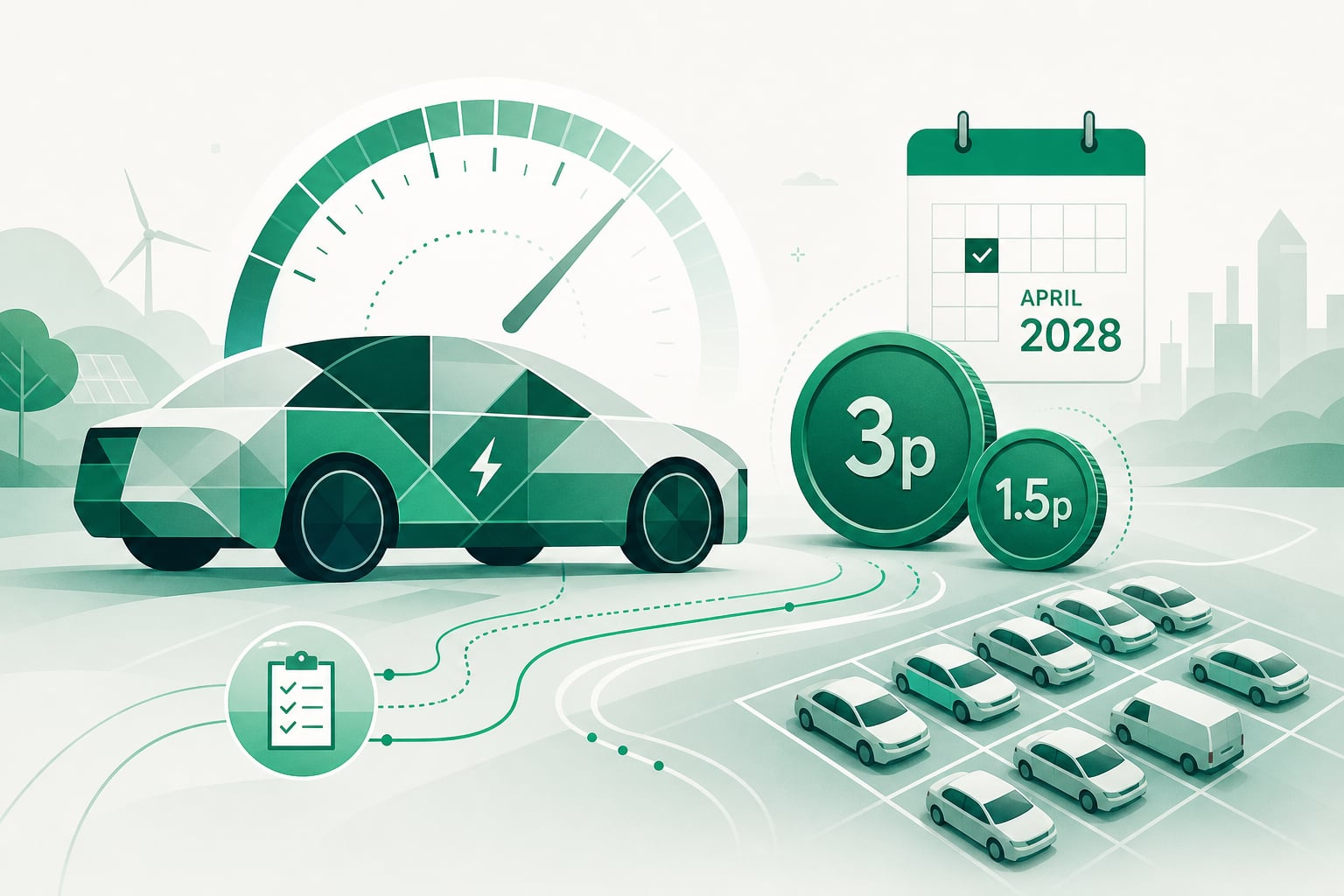
On 13 July 2026, HM Treasury published its response to the consultation on Electric Vehicle Excise Duty (eVED). The government confirms that eVED will apply from April 2028 to UK-registered battery electric cars and plug-in hybrid cars at 3 pence per mile for fully electric cars and 1.5 pence per mile for plug-in hybrids — half (and a quarter) of the equivalent fuel-duty benchmark used in the Budget 2025 design.
The consultation (26 November 2025 to 18 March 2026) drew 5,133 responses. Respondents backed the principle that higher-mileage drivers should contribute more, but raised concerns about EV uptake, administrative burden, and fleet complexity. The government is dropping the proposed extra mileage checks for vehicles under three years old (under four in Northern Ireland) that are not yet in the annual MOT cycle, relying instead on estimated mileage with reconciliation at the first MOT.
Scope, privacy, and how drivers will pay
At introduction, vans, buses, coaches, and HGVs are out of scope because electrification of those fleets is less advanced. eVED sits alongside existing Vehicle Excise Duty; the government restates there will be no mandatory in-car trackers. Payment is intended to use familiar DVLA / VED channels, typically once a year for many motorists, with flexible payment options and the ability to update mileage estimates in-year.
Optional future functionality may let drivers opt in to share mileage via a car’s built-in connectivity for a quicker experience — the government will update further by end of 2026. Around 80 per cent of eVED revenue from the first three years is earmarked for reinvestment supporting the EV transition, alongside a wider support package announced at Budget 2025 (including Electric Car Grant top-ups and a higher Expensive Car Supplement threshold for new EVs).
Fleet and leasing simplifications
Chapter 7 of the response significantly simplifies arrangements for fleets and leasing companies: estimated mileage readings, bulk licensing, and greater payment flexibility. That matters for SMEs and contractors running company car or grey-fleet policies — payroll and benefits teams should model eVED cash cost per mile from 2028/29 alongside benefit-in-kind and electricity reimbursement rules.
Businesses should inventory EV and PHEV cars now, note expected annual mileage, and update total-cost-of-ownership models used for salary-sacrifice or company-car decisions. High-mileage roles may see a clearer cash difference between EV and PHEV once both fuel duty (for hybrid petrol use) and eVED apply.
What finance and operations teams should do in 2026
Add eVED line items to 2028 budgeting models for every UK-registered EV/PHEV car. Engage leasing providers on how bulk licensing and estimated mileage will appear on invoices. Review expense policies so private versus business mileage evidence remains audit-ready when MOT reconciliations begin.
Track further Treasury / DVLA guidance through 2026–27 before systems go live. FinnAccountings helps UK and Ireland businesses track vehicle and travel costs inside organised bookkeeping and tax prep drafts with Chartered Accountant insight — start a free trial so fleet cost changes feed cleanly into management accounts before your ICAEW/ACCA or Chartered Accountant (Ireland) adviser reviews year-end packs.
Related FinnAccountings reading
See our Finance Bill 2026–27 Legislation Day briefing for other motoring and administration measures published the same week, and use the free tax calculator for high-level take-home estimates when modelling company-car versus cash alternatives.
Sources & references
This article draws on official guidance and publications from the sources below.
- 1.Consultation on the Introduction of Electric Vehicle Excise Duty (eVED)
HM Treasury · Accessed 2026-07-27
- 2.Electric Vehicle Excise Duty (eVED) — policy publication
HM Treasury · Accessed 2026-07-27
- 3.The introduction of Electric Vehicle Excise Duty (eVED): Government Response (PDF)
HM Treasury · Accessed 2026-07-27
- 4.Finance Bill 2026-27 — draft legislation and technical tax documents
HM Revenue & Customs · Accessed 2026-07-27
Put this into practice
FinnAccountings helps with bookkeeping, tax, and VAT prep for Ireland and the UK — with Chartered Accountant insight on AI drafts. Educational articles are not filing advice.
Try AI accounting free