
Ireland's 9% VAT Rate for Restaurants and Hairdressers Starts 1 July 2026
Revenue confirms a permanent cut from 13.5% to 9% for restaurant, catering, and hairdressing services from 1 July 2026 — what qualifies, what doesn't, and how to update your systems.
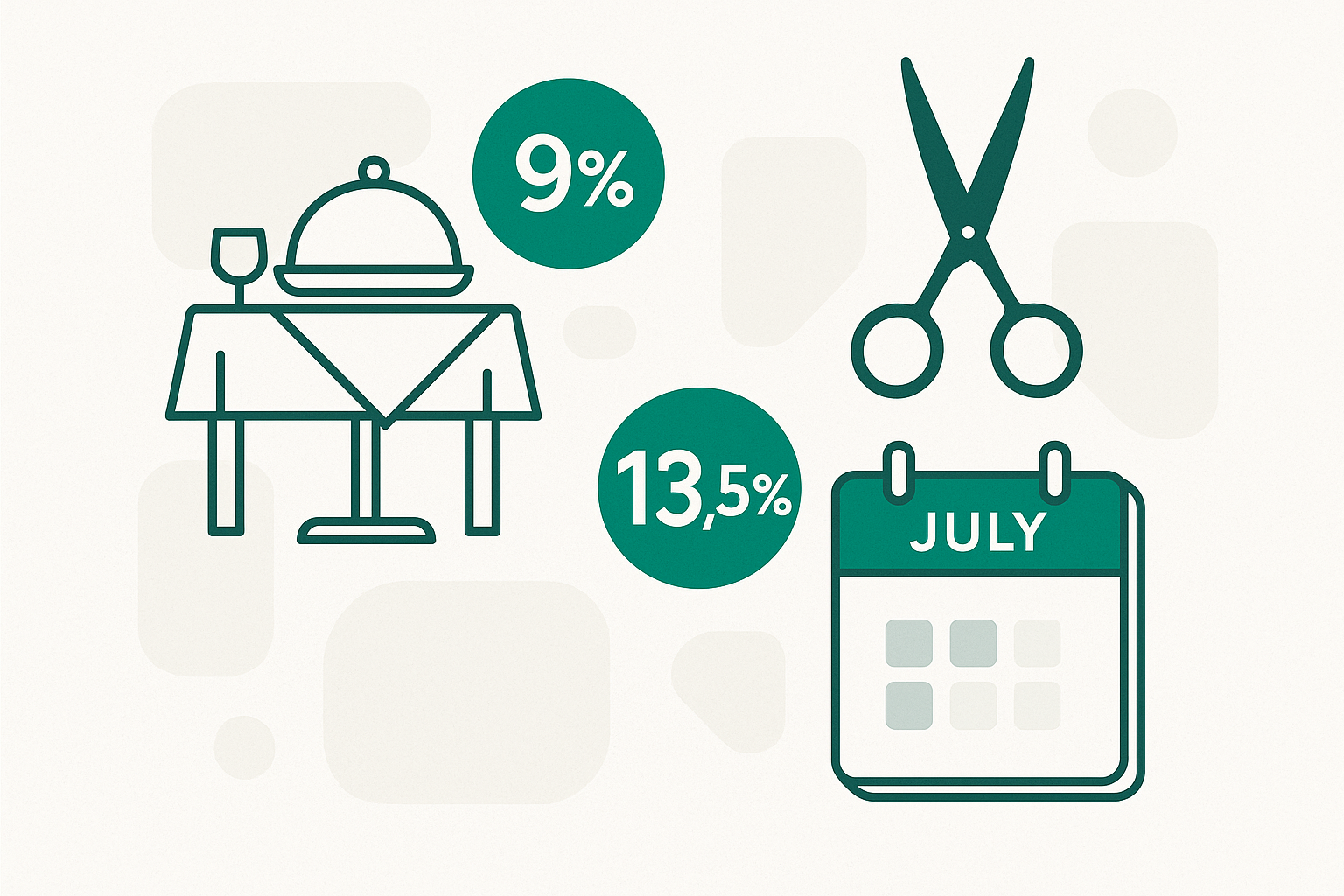
From 1 July 2026, Ireland's second reduced VAT rate of 9% replaces 13.5% on qualifying restaurant, catering, and hairdressing services. Revenue updated its guidance in April 2026, and the change is permanent — not a temporary Covid-era measure.
If you run a café, restaurant, takeaway, catering business, or salon, you have days to update tills, menus, invoices, and VAT returns. Get the split wrong on alcohol, soft drinks, or mixed packages and you risk underpaying Revenue or overcharging customers.
What moves to 9% on 1 July
The 9% rate applies to restaurant and café services consumed on the premises, catering services (including staff canteens where taxable), and hairdressing and barber services. Hot takeaway food — chips, burgers, hot sandwiches, and similar — also moves to 9%.
Hotel and guest accommodation stays at 13.5%. Completed apartment sales already benefit from 9% under separate Budget 2026 housing rules, but that is a different supply from day-to-day hospitality trading.
The cut is targeted at food-led and personal-care SMEs facing higher wages, energy, and insurance costs. Budget 2026 framed it as supporting jobs and household spending, not a blanket reduction across all tourism services.
What stays at 13.5% or 23%
Alcohol, bottled water, soft drinks, sports drinks, and vegetable juices remain standard-rated at 23% even when sold as part of a meal. Revenue's summary tables treat these as separate supplies — your POS must ring them at the correct rate, not bundle them into a single 9% line.
Cold sandwiches without hot fillings, confectionery, crisps, biscuits (except chocolate-covered biscuits), and most cold takeaway food follow their existing categories — many cold takeaway items remain zero-rated or standard-rated depending on the product, not the 9% hospitality rate.
Mixed packages — a hotel stay with breakfast, or a meal deal with a soft drink — need fair apportionment using standalone selling prices. A €100 package might split between 13.5% accommodation, 9% food, and 23% drinks. Document your methodology before Revenue asks.
Pricing, tills, and customer expectations
VAT-inclusive menu prices should reflect the new rate from 1 July. If you keep prices unchanged, your net revenue rises because less VAT is embedded in each euro — but customers may expect visible savings when the rate drops 4.5 percentage points.
Update every channel: in-house POS, delivery apps, online ordering, and printed menus. Bi-monthly VAT filers will straddle June and July periods — June supplies stay at 13.5%, July supplies at 9%. Your return must split correctly by supply date, not invoice date where they differ.
Cash-flow planning matters too. You collect less VAT per sale after 1 July, so the float between collection and Revenue payment shrinks. Accurate forecasting prevents surprises when your usual VAT cushion disappears.
VAT returns and record-keeping
Configure your accounting software with effective-dated VAT codes before 1 July. FinnAccountings VAT Agent applies rate rules by transaction category and flags items that typically attract 23% within hospitality businesses — alcohol, soft drinks, and standard-rated retail goods.
Keep till Z-reads or equivalent reports showing rate splits for the transition month. If you operate both eat-in and takeaway, remember takeaway can be a supply of goods with different rules from on-premises catering.
Farmers and flat-rate farmers are unaffected by this change directly, though Budget 2026 reduced the farmer flat-rate addition from 5.1% to 4.5% from 1 January 2026 — a separate compliance point for agricultural clients you may supply.
Checklist before 1 July
Audit your product and service list against Revenue's April 2026 guidance tables. Train staff on ringing alcohol and soft drinks separately. Test a sample week of transactions in your software at both rates.
Review contracts with delivery platforms — confirm who adjusts VAT-inclusive pricing. Speak to your accountant if you run events, weddings, or corporate catering with bundled supplies.
Start a free trial with FinnAccountings to connect sales feeds, categorise mixed-rate transactions, and draft VAT returns that reflect the July rate change automatically.
Sources & references
This article draws on official guidance and publications from the sources below.
- 1.VAT rates — hospitality services (9% from 1 July 2026)
Revenue Commissioners · Accessed 2026-06-26
- 2.Budget 2026 tax policy changes
Department of Finance · Accessed 2026-06-26
Put this into practice
FinnAccountings helps with bookkeeping, tax, and VAT prep for Ireland and the UK — with Chartered Accountant insight on AI drafts. Educational articles are not filing advice.
Try AI accounting free