
Ireland's €3 Customs Duty on Non-EU Parcels Is Now Live: What Online Shoppers and Sellers Owe
€3 customs duty Ireland from 1 July 2026: flat duty per distinct item on non-EU e-commerce parcels, plus Irish VAT — and IOSS filers still clear July returns by 31 August.
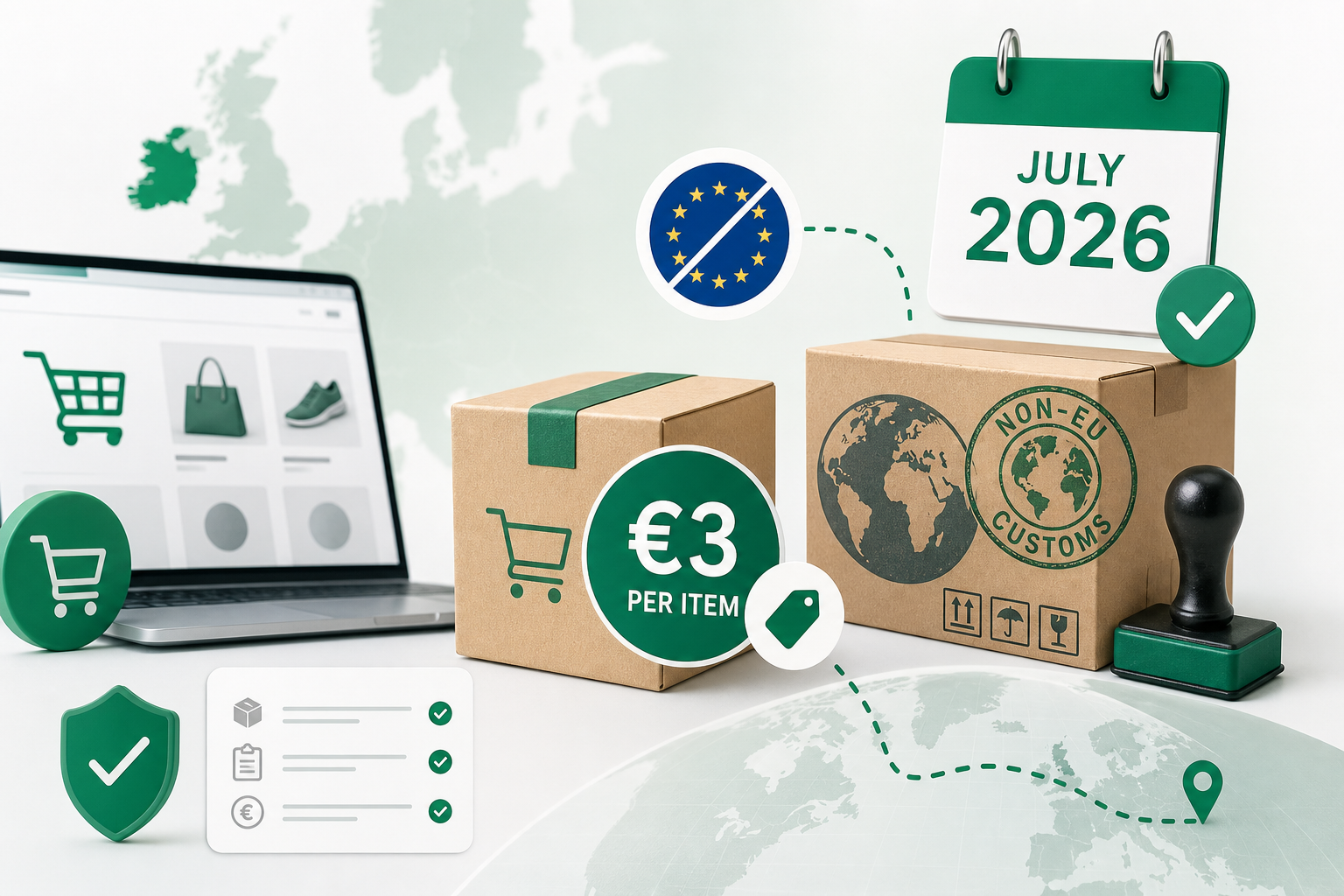
From 1 July 2026, the European Union abolished the customs duty exemption for low-value e-commerce consignments valued at €150 or less. Ireland applies the change through Revenue guidance and EU implementing regulations — a flat €3 custom duty (customs duty) per distinct item now applies to parcels entering from outside the EU, including Great Britain.
Revenue warned consumers in May 2026 that online purchases from non-EU sellers would become more expensive and that returns would work differently. The first week of July is when courier invoices, checkout totals, and delivery holds start reflecting the new charge.
How the €3 per-item duty works
Previously, e-commerce packages valued at €150 or less entered Ireland without customs duty — only VAT and delivery fees applied. From 1 July, each distinct product type in a parcel attracts a €3 customs duty charge regardless of individual item value.
Revenue's examples are clear: a package containing a pen, notebook, and keyring incurs €9 customs duty (three distinct items) plus VAT. Two identical pens count as one item — €3 duty plus VAT. The duty is included in the value used to calculate Irish VAT.
The measure is temporary under EU law until 1 July 2028, after which normal customs duty rates by product classification will apply to consignments up to €150. It covers distance sales to consumers regardless of whether the seller uses the Import One Stop Shop (IOSS) for VAT.
Checkout versus delivery: who collects the duty
Consumers pay the €3 duty in one of two ways depending on the retailer. Some websites collect customs duty at checkout, showing the final landed cost before payment. Others leave collection to the postal operator or courier on delivery — creating surprise charges if shoppers do not read terms and conditions.
If the retailer uses IOSS, VAT on the purchase is paid at point of sale and no further import VAT is due. Where IOSS is not used, VAT on import — including VAT on the €3 duty itself — is payable when goods arrive in Ireland.
Revenue urges shoppers to verify where goods ship from before buying. A .ie domain or euro pricing does not guarantee EU fulfilment — check Terms and Conditions and About Us pages for the physical dispatch location.
Returns, refunds, and business impact
The €3 customs duty is non-refundable on change-of-mind returns unless goods are faulty. VAT refund treatment varies by retailer — some refund VAT on returns, many do not, depending on how they account for liabilities. Read refund policies before ordering.
For Irish and EU businesses competing with non-EU sellers who previously avoided duty on sub-€150 parcels, the change levels the playing field. E-commerce importers and marketplace sellers should update landed-cost calculators, IOSS declarations, and customer communications.
Parcels above €150 continue to face standard customs duty rates by product type. Goods shipped from within Ireland or another EU member state are unaffected.
What to do now
Before ordering from UK, US, or Asian retailers, confirm whether customs duty is included at checkout or due on delivery. Budget for €3 per distinct item plus VAT on top of product and shipping costs.
Businesses importing low-value consignments should review H1 customs declarations, update pricing for Irish customers, and train customer service teams on the new landed-cost rules.
FinnAccountings tracks import VAT and customs charges alongside domestic VAT returns — start a free trial to reconcile cross-border purchase costs with your Irish tax filings.
Sources & references
This article draws on official guidance and publications from the sources below.
- 1.Revenue advises online shoppers of new Customs rules for goods from outside the European Union (EU)
Revenue Commissioners · Accessed 2026-07-07
- 2.Removal of the De Minimis Relief for Low Value Consignments – 1 July 2026
Revenue Commissioners · Accessed 2026-07-07
- 3.Buying goods from outside the European Union (EU) (Excluding Northern Ireland)
Revenue Commissioners · Accessed 2026-07-07
Put this into practice
FinnAccountings helps with bookkeeping, tax, and VAT prep for Ireland and the UK — with Chartered Accountant insight on AI drafts. Educational articles are not filing advice.
Try AI accounting free